The
Wringer
Paste the task you are about to hand an AI agent. For $1 The Wringer stress-tests it and returns a graded dry-run plus a repaired, verifiable work order. For $10 a multi-agent swarm actually does the job and has to prove it.
Say it out loud
Describe the job like you would to a smart coworker. Grok fills goal, checks, and boundaries.
Pick the press
$1 Audit finds weak spots first. $10 MECHA Run actually does the work with a swarm and a reviewer.
Read the verdict
Grades, exit code, evidence chain. Honest failure beats fake SUCCESS every time.
What you actually get
Three tiers, each does something different. Free drafts the contract. $1 stress-tests it. $10+ runs the job in a sandbox and proves the result.
Grok Coach
Describe the job in plain English. Grok drafts goal, acceptance criteria, and boundaries. You get the contract shape without paying.
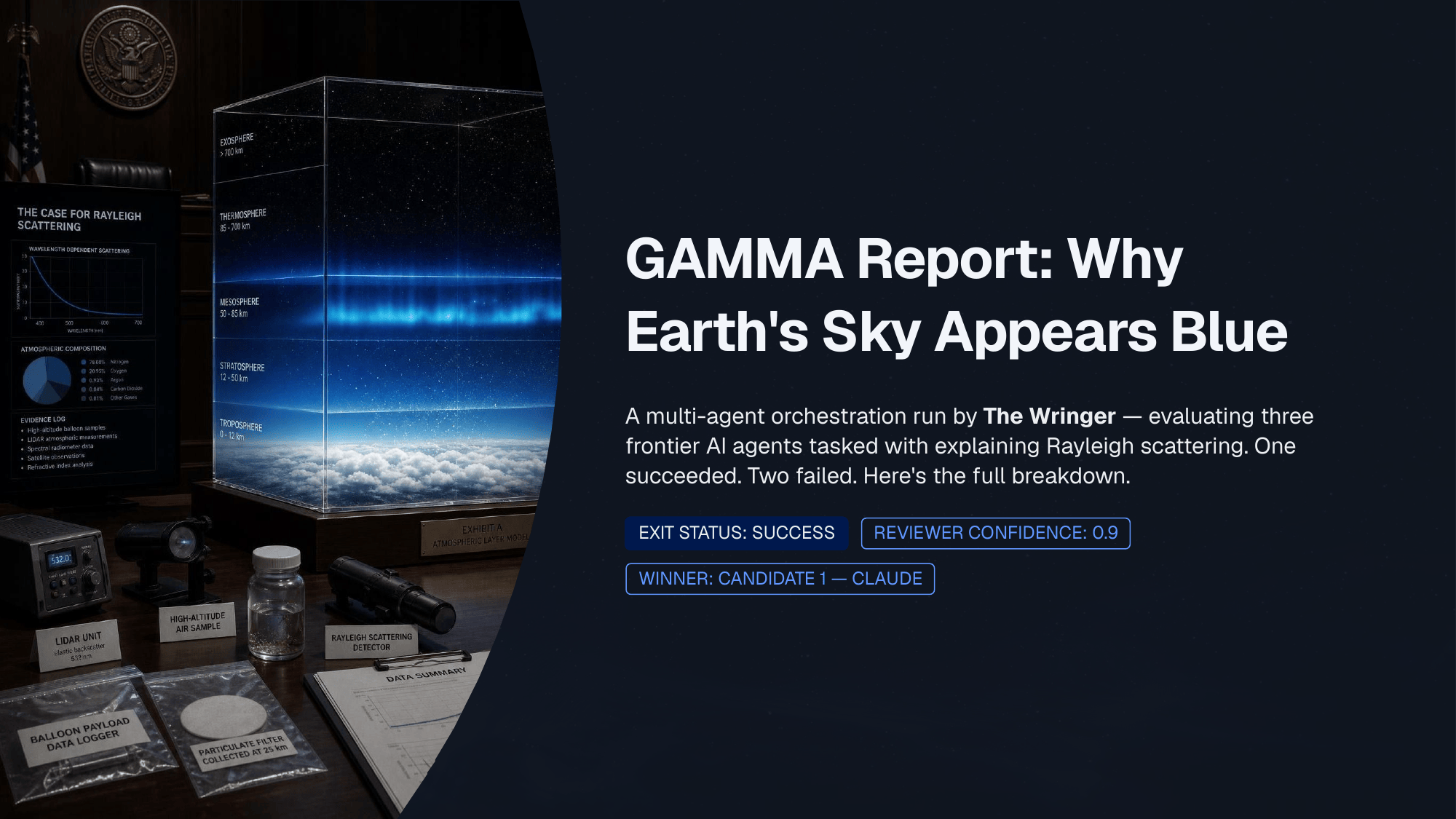
Goal: Confirm that Earth's daytime sky
appears blue due to Rayleigh scattering

Acceptance Criteria:
[AUTO] Cite peer-reviewed source
[AUTO] Explain wavelength scattering
[AUTO] State why blue, not violet

Boundaries: No sunsets, no other planets
Audit
Stress-tests the work order. Finds vague checks, missing boundaries, unverifiable claims. Returns a graded dry-run and repaired contract.
<verdict>
  grade: A
  predicted_exit: 0 SUCCESS
  one_fix: Add scattering intensity
</verdict>

Repaired:
[AUTO] Cite Bohren & Clothiaux
[AUTO] State 1/wavelength^4 law
[AUTO] Explain cone-cell sensitivity
MECHA Run
Real sandbox execution. Multiple agents take the job. A reviewer picks or merges the best. You get live telemetry, an exit code, the GAMMA HQ report, and presentation links when available.
[BOOT] mecha-1788103355-4bd3f4 strategy=triumvirate
[FANOUT] triumvirate - 3 workers: Claude, Codex, Grok
[WORKER] Claude (claude) engaged
[WORKER] Codex (codex) engaged
[WORKER] Grok (xai) engaged
[WORKER] Grok answered
[WORKER] Codex answered
[WORKER] Claude answered
[REVIEW] Reviewer (Claude) judging 3 candidates
[REVIEW] Reviewer (Claude) verdict in
[DONE] cost=$0.7714 time=363.2s
[GAMMA] compiling HQ report (anthropic/claude-opus-4.1)
[GAMMA] HQ report ready · $0.3171 · 63.7s
[GAMMA] generating HD presentation
[GAMMA] HD presentation ready · 100.6s
Exit codes
Chat with Grok
Type the messy version. Grok writes the clean work order below. Edit anything before you pay.
Work Order
REVIEW · EDIT · THEN PRESSAgent docket
Ask your browser agent: Turn this request into a case file, then review what cannot be verified.
No agent calls yet. Human controls remain fully available.
One plain sentence. What does done look like?
Simple pass or fail checks. "Auto check" if a computer can prove it. "I'll look" if a person has to confirm.
Boundaries. Stops the agent from wandering.
How many attempts before it stops. Around 30 is fine for most jobs.
Only if you want send, publish, delete, or charge. Leave blank for the safe lane.
How to read what comes back
Audit ($1)
- Repaired criteria means your checks were fuzzy. Keep the fixes unless they changed your intent.
- Dry-run grades show whether the loop could even pretend to verify the work.
- If it says the goal is uncheckable, fix the form before a MECHA run.
MECHA Run ($10+)
- Exit 0 SUCCESS means every check got real evidence. Rare and earned.
- PARTIAL / NEEDS_HUMAN / STALLED still helps. Read what failed and why.
- Winner / candidates is the evidence chain. Open the winner first.
- Model cost is LLM spend inside the sandbox, separate from your Wringer fee.
Good inputs look like
- Goal names a finished state: "customers can reset passwords", not "look at login stuff".
- Each check is something a stranger could prove without guessing.
- Boundaries stop surprise rewrites.
- Risky actions stay blank unless you truly want send, publish, or delete.
Write work orders that verify
Four short guides on the part of agent work everybody skips: the contract.
Questions people ask
What is The Wringer?
It turns a vague AI agent idea into a checkable work order, then gives you two ways to use it: a $1 audit that stress-tests the contract before anything runs, or a MECHA multi-agent run that actually does the work and has to prove the result.
How much does it cost?
The Grok coach and the form are free. A work order audit is $1. A MECHA run starts at $10 and scales with the number of agents you spin up.
What does the $1 audit actually do?
It reads your goal and acceptance criteria like a hostile reviewer, finds the weak spots (vague checks, missing boundaries, unverifiable claims), and returns a graded dry run plus a repaired work order you can apply in one click.
What is a MECHA run?
MECHA dispatches your compiled work order to a real multi-agent swarm in an isolated Daytona sandbox. Workers fan out under a strategy you pick, a reviewer synthesizes the final answer, and you get the full evidence chain back.
Is my work order private?
Work orders are sent to the audit model or the sandbox only when you run them. There is no Wringer database of your prompts. For paid MECHA runs, you receive an email copy of the GAMMA report and any available presentation links at the address you used at checkout. That email is held by our mail provider (Resend) per their retention policy. The live results page is session-only.
How is this different from just pasting a prompt into ChatGPT?
A chat model gives you text. The Wringer gives you a contract with checkable acceptance criteria, then verifies the result instead of trusting it. Honest failure beats fake SUCCESS, and the exit code tells you which one you got.