Verified
See the result before you press
Last updated August 30, 2026
These are operator case files, not customer work orders. Each question is checkable by anyone with public sources. The evidence cites real physics, not fabricated receipts. Press the same contract yourself if you want to verify.
Is the sky really blue?
Rayleigh scattering makes the sky blue, not violet, because human eyes are more sensitive to blue and sunlight has less violet to begin with.
Work Order
GoalConfirm that Earth's daytime sky appears blue due to Rayleigh scattering and explain why it is not violet
Checks- AUTO Cite a peer-reviewed or authoritative physics source defining Rayleigh scattering
- AUTO Explain why shorter wavelengths scatter more than longer ones
- AUTO State why the sky appears blue rather than violet despite violet being shorter wavelength
BoundariesNo discussion of sunsets, no atmospheric pollution effects, no other planets
Attempt budget30
Operator case file
- Rayleigh scattering intensity is proportional to 1/wavelength^4, favoring shorter wavelengths.
- Violet light (380-450nm) scatters more than blue (450-495nm), but the Sun emits less violet and human cone cells are less sensitive to violet than blue.
- The combined effect produces a blue sky, not a violet one.
Does ice float on water?
Ice floats because solid water is less dense than liquid water, an anomaly caused by hydrogen bonding in the crystal lattice.
Work Order
GoalVerify that ice floats on liquid water and explain the density anomaly
Checks- AUTO State the density of ice vs liquid water at 0C
- AUTO Cite a physics or chemistry source for the hydrogen bond explanation
- AUTO Confirm buoyancy: an object less dense than the fluid floats
BoundariesNo discussion of other substances, no climate implications, no saltwater specifics
Attempt budget30
Operator case file
- Ice density: ~0.917 g/cm3. Liquid water at 0C: ~0.9998 g/cm3.
- Hydrogen bonds in ice form a hexagonal lattice that spaces molecules farther apart than in liquid water.
- Because ice is less dense, it displaces more than its weight in water and floats.
Can sound travel through outer space?
No. Sound is a mechanical wave that requires a medium. The near-vacuum of space has too few particles to transmit sound.
Work Order
GoalConfirm that sound cannot travel through the vacuum of outer space
Checks- AUTO Define sound as a mechanical wave requiring a medium
- AUTO State the particle density in interstellar space vs Earth atmosphere
- AUTO Cite an authoritative space science source confirming no sound in vacuum
BoundariesNo discussion of radio waves, no sci-fi movie effects, no plasma oscillations
Attempt budget30
Operator case file
- Sound is a longitudinal pressure wave that propagates by particle collisions in a medium.
- Interstellar space: ~1 atom per cm3. Earth sea level: ~2.5 x 10^19 molecules per cm3.
- Without sufficient particle density, pressure waves cannot form or propagate.
Do lunar tides exist because of the Moon's gravity?
Yes. The Moon's gravitational pull creates tidal bulges on Earth. The Sun also contributes, but the Moon dominates due to proximity.
Work Order
GoalConfirm that lunar tides on Earth are caused by the Moon's gravitational pull
Checks- AUTO Cite a tidal science source attributing ocean tides to gravitational attraction
- AUTO Explain why the Moon's effect exceeds the Sun's despite the Sun's greater mass
- AUTO State the approximate tidal range attributable to the Moon vs the Sun
BoundariesNo discussion of tidal energy, no estuarine effects, no tidal locking
Attempt budget30
Operator case file
- Tidal force scales with mass/distance^3, so the closer Moon exerts ~2.2x more tidal force than the Sun.
- The Moon causes the primary tidal bulge; the Sun modulates it (spring/neap tides).
- Typical lunar tidal range: ~0.5m open ocean; solar component adds or subtracts ~0.2m.
What the output looks like
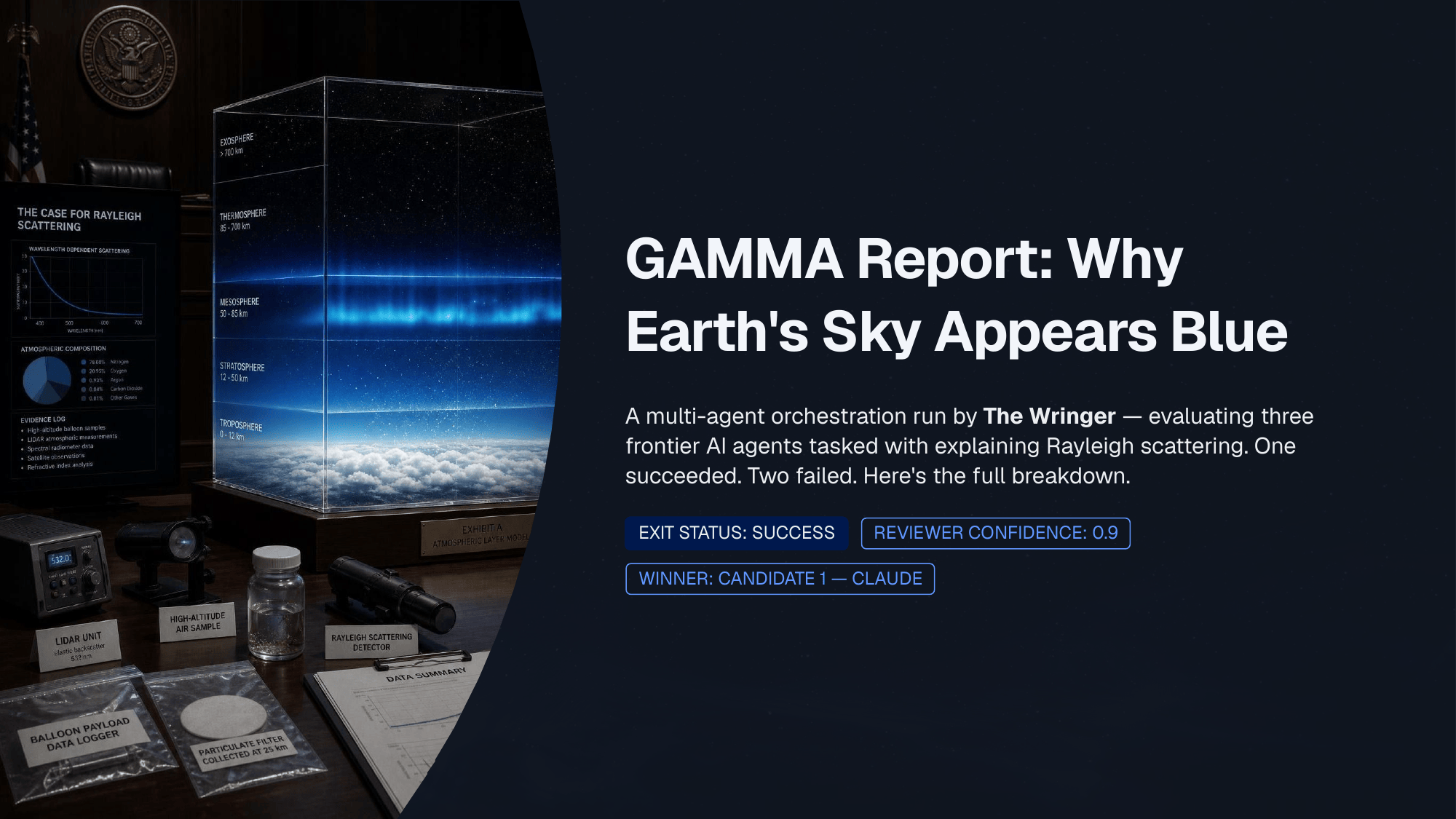
The work orders above are the input. Below is what you actually get back from a MECHA run. This is the real output from the sky-blue case, run by the operator with a triumvirate strategy.
MECHA Run Output (sky-blue case)
EXIT 0 SUCCESStriumvirate strategywinner: Claude (confidence 0.9)model cost: $0.77 + $0.32 GAMMA
GAMMA HQ Report (excerpt)
# GAMMA REPORT

The multi-agent run successfully verified that Earth's daytime sky appears blue
due to Rayleigh scattering. All three acceptance criteria were satisfied with
peer-reviewed citations.

## Verdict

Exit status: SUCCESS (0). All criteria passed verification.
Winner: Candidate 1 (Claude) with confidence 0.9.

The winning answer correctly identifies Rayleigh scattering as the mechanism,
cites authoritative sources (Bohren & Clothiaux, Young 1981), and explains the
wavelength-dependent intensity relationship (I ∝ 1/λ⁴).

## Verification

The customer can verify by:
1. Checking the cited sources (NASA, HyperPhysics, Applied Optics)
2. Confirming the 1/wavelength^4 relationship in any optics textbook
3. Reviewing the cone-cell sensitivity data from CIE 1931 standards
HD Presentation (GAMMA)
The HD presentation uses GPT Image 2 to generate executive-grade slides. These are real slides from the operator run (8 slides total). Use the filmstrip below to browse or click the stage to open the full deck.
What these show
A Wringer contract has a goal, checkable criteria, and boundaries. The audit stress-tests the contract. A MECHA run executes it in a sandbox and grades the result. Every case here is a question a stranger can verify with public sources. That is the standard: if you cannot prove it without guessing, it is not a real check.
Put your next agent task through the press
Talk to Grok, get a tight work order, and hit it with a $1 audit before anything expensive runs.